
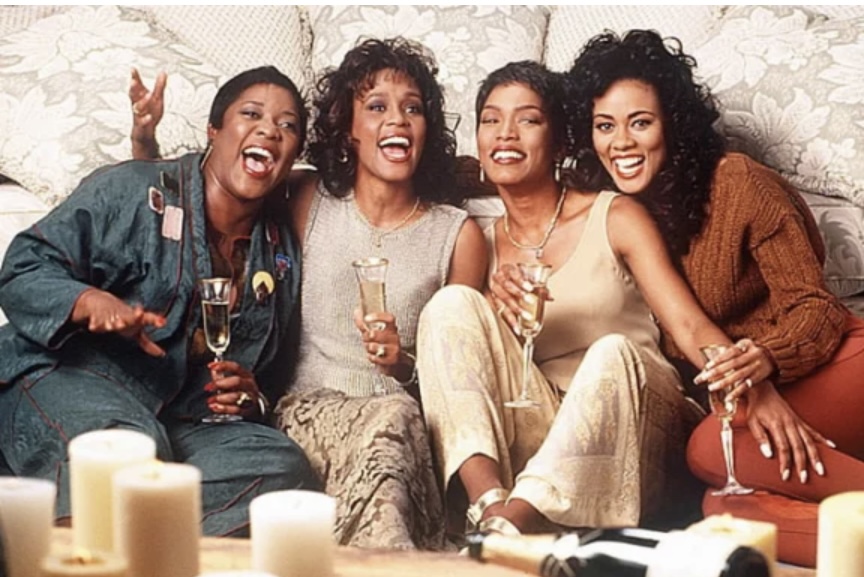
This past Saturday, I had the beautiful experience of viewing the 90’s iconic film, “Waiting to Exhale,” with an intimate group of black women, followed by leading a discussion about the movie. The event was hosted by a non-profit organization, Black Women for Self, founded by Samjah Iman and Chaila Scott. Black Women for Self’s mission is to help elongate the lives of Black women by starting a radical self-care revolution that encourages them to release, rest, and pour into themselves.
I was in middle-school, in 1995, when Waiting to Exhale made its debut. And here I am, 29 years later, still re-watching this film at every stage of womanhood. While I experience the movie differently at each stage, it continues to be relevant. Each time I watch, I leave with a new perspective on my own life and journey through Black womanhood.
Waiting to Exhale is a timeless classic for black women. The most powerful and consistent theme throughout the movie is sisterhood. The film powerfully, immerses viewers into the concept of squad care and leaves us doing a deep dive into our own friendship groups and the collective power that can exist when we have the privilege of sharing our joys, sorrows, and life experiences with our social support system…and for a lot of women that comes in the form of what’s commonly referred to as sister circles.
“Squad care reminds us there is no shame in reaching for each other and insists the imperative rests not with the individual, but with the community. Our job is to have each other’s back.” – Melissa Harris Perry
Life’s challenges can sometimes feel overwhelming, but having the ability to open up to friends and loved ones—who stand with you as your primary support—can significantly lighten your load. When you share your struggles with those who care, life’s burdens become easier to bear and more manageable.
Let’s explore some of the themes that resonated with me at my current stage of black womanhood.
- Caretaker & Prioritizing the care of others over oneself: Gloria (Loretta Devine) was completely immersed in the role of caretaker. She had no identity outside of that role. Even in her professional life, as a hairstylist, she was caring for others. She completely robbed herself of the human need for romantic connection and partnership. The only time she gave herself permission to connect with someone sexually, was once every couple of years, with her son’s father who revealed that he struggled to connect with her because he identified as gay. She created a small prison for herself, desexualizing herself, and confining to the rigidity of her caretaking identity. When she finally allowed herself to be free of her own judgement, she found happiness.
- Passing down narratives intergenerationally, that do not serve us and actually cause harm. Savannah (Whitney Houston) had a very meddling mother who encouraged her to pursue having an affair with a married man. Her mom’s iconic line, that many of us still use today, “that’s a good man Savannah,” has become a common saying among black sister circles. Savannah’s mother lived in poverty and struggled to meet her own basic needs. Her mom saw partnership (having a man) as essential to economic survival. She didn’t want her daughter to endure similar struggles and she was so tainted by her own experience that she was unable to recognize her successful and educated daughter’s ability to take care of herself without having a man in her life. Although what she was imposing on to Savannah came from a place of love and protection, she caused harm. When Savannah freed herself of the life her mother was imposing on her, she found happiness.
- Self-Betrayal & Perfectionism can present in the form of people pleasing to meet the standards of a significant other. It can cause us to step out of alignment with ourselves and the dreams we have for our own life. Bernadine (Angela Bassett)!!! Bernadine, dutiful wife and mother, was completely engulfed in her husband’s ideas about what he wanted his wife and family to look like. She fully immersed herself into his dreams, abandoning her dream of owning a catering company and putting her MBA to use by creating her own career pathway. Her life had become completely about supporting him. His affair with a white co-worker and his decision to end their 11-year marriage was the disruption of everything. This life event forced Bernadine to reckon with the ways in which she abandoned and betrayed herself, in the form of self-sacrifice, in order to advance her husband’s dreams and goals. When she was forced to reckon with that truth, she took agency over her own life and found freedom there.
- The Search for Belongingness: Robin (Lela Rochon) is my favorite character. Robin was the character that was most honest with herself. She gave herself permission to be the most vulnerable. It was through her honesty and vulnerability that she demonstrated the greatest strength, of all the characters. While Robin made a series of poor decisions in her dating life, she demonstrated self-awareness by consistently checking-in with herself throughout the time that she was choosing to engage in various unhealthy relationships. As she realized that these relationships were not fulfilling her or not serving her, she ended them. This is how we learn and grow…these are growing pains! She used those experiences to learn more about herself and what she was searching for in those relationships, which was a sense of belongingness. Robin freed herself of the search to find a sense of belongingness in relationships with romantic partners, ultimately recognizing that she belonged to herself. I think her journey of personal enlightenment was most powerful. Robin was able to find harmony (not happiness) in holding two truths at the same time. While she desired to be in a loving and fulfilling romantic relationship that gave her a sense of belongingness, she was not in one and that felt lonely. However, she did belong to a loving and fulfilling sister circle where she felt connected. When she was able to hold these two truths, she set herself free.
Rigid and static identities can trap us, disconnecting us from our true selves and leaving us misaligned. This is especially pertinent in the context of black women’s lives, where identity often feels imposed by historically negative stereotypes, rather than self-defined.
Although sisterhood isn’t a panacea, it provides essential comfort, safety, and the freedom needed for black women to navigate spaces that often feel distorted and unjust. It reinforces the understanding that it is not the individual who is skewed, but rather the environment around them. Sisterhood acts as a protective shield, highlighting and valuing aspects of black women that are otherwise ignored or unseen.
The health of black women is a layered issue characterized by resilience but also marred by disproportionately negative health outcomes. Addressing this topic necessitates recognizing how racism, sexism, and socioeconomic status further marginalize black women, creating societal conditions that perpetuate health disparities. Importantly, it also involves acknowledging the resilience of black women in creating and maintaining healing spaces for themselves and others, in spite of the systemic barriers that challenge their health and well-being.
Black women have managed stress through a strategy of “tending and befriending,” a term introduced by Dr. Shelly Taylor to describe how women support each other during stressful times. This squad care approach, allows black women to heal through the power of shared identity and experiences. It is the sovereignty of sisterhood that helps us to combat the invisibility imposed by pervasive racist and sexist oppression.
 Providing you with tips and tools from a licensed therapist to support the development of your emotional intelligence
Leave a comment